Showing posts with label sculpture how-to. Show all posts

Monday, September 29, 2014

Anton

I've been working on this commission most of this year - well, "pondering" quite a lot of that time rather than actually sculpting.  One problem is, the horse has only one leg on the ground, which isn't enough support for the sculpture.  The other big problem was, how do I translate that massive clump of hair (his mane) that's lying on his side into a flowing form that will look good and be reasonable to clean up, rather than looking like a tangled mess?  Thankfully, I've solved or figured out how to solve those problems.

Here's the pose photo, a gorgeous picture of the Friesian stallion Anton by world-renowned photographer Gabrielle Boiselle.
Ms. Boiselle kindly gave permission for me to sculpt this pose, for which my customer and I are very grateful.

Looking at the picture, you can see my problem with only one leg being down.  There's a tremendous amount of weight ahead of that leg and not that much behind, so it won't "balance" on that leg.  There needs to be another leg attached to the ground for support, so that other hind leg will be shown as moving through a tall clump of grass.  I'm not at that point in sculpting yet, but I'll share it when I get there.

First, I had to build the horse and get him fairly finished before adding the hair.  I've just started laying on the clay for his tail here and having started the feathers yet.  His eyes are ball earrings, in case you wondered.  It's easier for me to sculpt expressive eyelids if I have a hard eyeball to work with, rather than doing the eye in clay or wax.  And this way, the eye is genuinely round, not lumpy like a wax ball would be (at least in my hands - I don't work with wax as well as I'd like).

Early work on the mane and feathers.  Each leg is at a different moment in flight, so the feathers "fly" differently on each leg.  This horse has massive feathers as well as a massive mane and tail, so there will be a LOT more clay on him before he's "right" - and yes, that's a LOT of hair to sculpt!

At various points during my work, I get the piece off the base and hang it upside down so I can work on the underneath parts without turning myself into a pretzel (as I did for years before fellow sculptor Cathy Choyce told me about this method).  This is by far the easier part of this kind of work, since I can work with my arms at a normal level (as if I were typing). With most pieces, I work with the horse's back supported by my legs, but with that mane in the way, Anton has to hang free. Him hanging free means I have to brace him with one hand while sculpting with the other, which can be difficult at times, but still, it's a lot easier on my shoulders and back than leaving it on my usual sculpting stand and trying to twist my body to see underneath him!

For those who haven't seen this setup before, the chain slides through a hole somebody put in the joist overhead such as pipes would go through. (In my previous studio, I had an eye-bolt attached to a joist in the ceiling.)  I have carabiners and S-hooks holding it where I want it. I keep a spare plumbing T on the chain so I can unscrew my armature from the working surface and screw it to the T to hang the piece upside down. I sit in the black chair with the necessary tools and some clay on the wooden stool beside me at a comfortable height.

You can see my normal sculpting stand to the left of that photo and the drafting stool I normally sit on. The stand is adjustable by turning a crank which raises and lowers the top. This stand was worth the cost, as often as I change the height of my stand. My old stand was one of those where you insert a pin in the support pipe at various heights, but you have to LIFT the top to the place where you want it. I still use the old one at times. I don't throw much away . . .


This pic shows what I need to work on (as well as how much work I've done on the feathers). The hooves need to have the details (wall, sole, frog, heel bulbs) added, and there are holes or voids in the clay here and there (look at the tail and feathers for examples) that need to either be blended or filled so they won't catch the mold material and possibly tear the mold. I also need to smooth out his belly and other parts. By hanging him like this, I can make sure everything is blended, filled in where necessary and sculpted properly. After I hung him up I noticed the bone in the forelegs didn't show correctly, so I fixed that as well as a bunch of other stuff.  Changing your point of view is always helpful in perfecting an artwork.  I also use a big wall mirror to see it with fresh eyes.

All that hair means there are lots of undercuts. Undercuts are fine in bronze to some extent, but again, I have to fix anything that might trap the mold - voids or undercuts that get larger "inside" or "under," for instance. Silicon molds are very forgiving, but there's no point in tempting fate by leaving such things that can be repaired. Sculpture is about light and shadow, so there will be some places that LOOK like undercuts, but they will be angled inside the cut to allow the mold to pull free smoothly.

Once I get the underneath parts fixed, I'll put him back on his working surface and glue the pipes in place - he won't be coming off there again until he's at the foundry. Then I'll add the grass under his feet and build it up to support that flying back leg, detail his tail, finish detailing his mane and forelock and sign him!! Then he'll be DONE and can go to be cast! YAY!

Once I get him upright again, I'll post some more pictures.  I hope this article was educational and entertaining!

Sunday, February 27, 2011

Progress, progress, progress!

I wish I'd taken a picture of Nanning's head when I finished work today - I spent most of today on it and there are a lot of changes.  I'll just have to post the pic another day!

In the meantime . . . I've done a lot of work on his back legs and rump, and now he has four legs, which I'm sure will make him very happy!  LOL  Normally I work with the horse's feet on the ground and build up "grass" around his feet, so I don't have to pay attention to how "level" they are - it all works out fine when they're on the ground.  But this one's in mid-air for several reasons.  For one thing, the owner wants the piece to be of just the horse, no ground under him, and for a life-sized piece, that's a good design.  It saves money (less bronze to cast, less weight to support, less expense in shipping, etc.) and looks more natural than it would with a "pad" of grass under it as a life-size horse.  To balance, three feet have to touch the ground, so I've had to lower the right hind leg to have the toe touch the ground, which isn't the way it is in the photo, but it's only off by a few inches.  I also had to straighten his front leg, which is bent in the photo, so he would have two feet completely flat on the ground, which will make him stronger.

Here's how I'm checking how level his feet are:
That's a piece of cardboard (from a calendar) that I've cut a slot in so it will fit around the post.  The level is way off right now, but the right front hoof still has a wire sticking out of the bottom, so it won't be level front to back until I cut that off.  I was mostly checking to see how the back feet were doing.  They're not too far off, so I'm happy about that.

Here's how he looked yesterday before I did all that work on his head.  I'll post the revised (and much prettier) head soon.


I'm still not happy with his hind legs, but he's in such an extreme posture (he was playing - horses can get into all kind of extreme positions when they play!), it's hard to get it exactly right early on.  My way of working is to build the horse too big and with everything in place as well as possible to start with, then carve away what isn't the horse I'm working on, making adjustments, either tiny or large ones, as needed.  He'll be gorgeous and his pose will make sense once I'm done with it!  I think I have at least a month's more work to do before he's finished.

The jumper is painted and finished, ready to be mounted on the walnut plaque.  Here's how it looks finished.  It's name is "Rolltop."

It's on a paper towel that has black paint and gold Rub 'n' Buff on it from me finishing a bunch of medallions as well as this relief.  I'm happy with how this turned out!  I think it will make a beautiful trophy.

Monday, February 21, 2011

Update on Jumper Commmission and Frieisian Maquette

The jumper commission ("Rolltop") is sculpted, the mold has been made and I've been making castings.  The first casting is usually one that has to be thrown away, because that's the one where I find the places where the mold catches on the resin.  When it "catches," that usually means the mold material has gotten stuck in the resin and torn off the mold.  These are usually TINY places, so they don't usually damage the detail of the mold.  The first casting also removes any clay that may have remained in the mold.  So the first one is tossed.  I've gotten a good casting now, so it just needs to be cleaned up (washed with Dawn dishwashing detergent to remove any oils from its surface), painted with a prime coat and then finished to look like bronze.  Here's are pics of it in the mold and right after I unmolded it.


The Friesian maquette for a life-size bronze is coming along well.  It's still rough, but the proportions are getting there, and some of the details are starting to show.  Remember, this is a work in progress - it will be in "the uglies" for a while yet.


His body is curved, as if he's turning to the left.  Hopefully it looks like that!  I know his hooves that are flat to the ground aren't quite on the same plane yet - that will come with a bit more work.  Ignore the position of the tail - it's just a "placeholder" for now. 

I try to work all over the sculpture at the same time, without focusing too much on any one spot.  So while the head looks almost finished, it isn't.  While the left hind hip and leg look nearly finished, they aren't.  Everything's being developed a little at a time.  I can see the beautiful horse starting to emerge, although most people will probably not see beyond his current not-yet-beautiful state.

I'm finding the hard clay difficult to work with.  My shoulders are sore all the time despite using a hair dryer on the sculpture to soften the clay before I try to blend it or add more or carve some off.  Some of my ribbon tools are being damaged from trying to carve this clay.  I sure hope the results are going to be worth the effort of using this kind of clay!   It's good to learn how to use a different kind of sculpting medium, but I'll be happy to go back to the soft clay I normally use.

Saturday, January 29, 2011

Sculpting with Gloves On and Other Adventures

I'll bet you read that title and said, "Huh???"  LOL.  Read and learn!

I got a "rush job" yesterday, a trophy job that involves me sculpting a relief of a jumper.  After I sculpt it, I'll make a mold and cast a resin of it, then finish the resin to look like bronze.  The problem is, the trophy has to be finished and in their hands by the end of March.  That isn't much time to get such work done, but fortunately for me and the customer, the big piece I'm working on requires a lot of "down time" while the clay is softening in the crock pot, so while the clay is becoming soft enough for me to use, I have time to work on other projects.

I'll back up and explain a bit here.  I'm using a crock pot as a double boiler to soften the Classic Clay Hard that I'm using on maquette for the life-size bronze I'm working on (I'll call it "Nanning," the real horse's name, to keep things simple).  It takes a while for the clay to soften even with the crock set on "high," so while it's warming, I have time to work on other things. 

I don't want to leave the crock plugged in and turned on while I'm not in the studio, so I don't turn the corck on and leave the studio while it warms the clay.  I've got the rider for "Tolt" nearly perfected and need to give that piece a couple of days of not being looked at so I can see it with fresh eyes before I do whatever touchups seem necessary.  Then I'll photograph it and send the pics to my client for approval.  I don't want to start working on the wings for the Pegasus I'm doing using "Feather" http://www.thesculptedhorse.com/feather.html as the horse's body because working on the wings takes both hands and my left shoulder is still sore and weak.  I don't have enough working room to get "Horseplay" out to work on while Tolt and Nanning are out.  With all my other current projects on "hold" for various reasons, I have time to work on this trophy relief while waiting for the clay to soften for Nanning.

My trophy customer sent me an excellent reference photo of a college-age rider jumping a nice hunter fence.  The background was very busy, with white vinyl fence behind the mostly white jump and people and a building there as well.  To  make it easier to see what I was doing, I cut the horse and fence out after printing the photo on my computer printer at the size I wanted to sculpt it.  To get it centered on the foamcore board I'm using as a working surface, I marked the outline of it on the foamcore.  This way, when I sculpt the piece, it won't be too far to one side or the other, and the mold will be much better as a result, with no possibly weak sides from being too narrow.

 Hopefully you can see the pencil outline on the foamcore above.  The cut-out reference picture that's been made the size I want it to be for the trophy is to the right.

Once I have the board marked, I start putting clay on the board to fill out the silhouette of the horse.  I will finish the horse first, then add the saddle, bridle, reins and rider (not necessarily in that order), and will build the jump and the bushes on either side of it last.

The trick to doing good reliefs is to remember that the parts closest to the viewer need to be the highest.  That seems like something that should be simple to do, but it isn't as easy to do as you might think.  Consider this horse's back legs.  The left hind leg is nearest the viewer.  That one has to be the highest.  You'd think the right leg would be the next highest thing, but this is a gelding and his sheath is showing, so the sheath has to be the second highest level and look as if it actually belongs between the back legs.  The right hind leg will be the least high.  The "least high" part still has to have a decent amount of depth top to bottom (as you look at the clay, not top to bottom of the leg) so the resin will pour well and the resulting piece won't be too thin and warp.  I have to be sure even the thinnest parts of the relief will pour well and be thick enough to be strong, but not so thick the piece loses its graceful appearance.  That's a trick in itself.

In the picture below, I've done about 45 minutes of work on the piece (with a couple of breaks to check on the clay in the crock).  You should be able to see the definition and different levels of the two back legs and the sheath.  The back legs, rump, top of the tail and the back part of the belly are all in pretty good shape now, although I need to detail the legs, of course.  I'm making this using the Classic Clay Soft I normally use.  I like it because I can push the clay around to get the various shapes needed without a lot of work, so my hands don't tire so easily.


The photo shown on the left above is the full photo.  It's about 1/3 bigger than the one I'm using for the sculpture.  You can see how the white vinyl fence behind the jump is distracting to the eye.  Having it cut out makes my job go faster - it's a nice shortcut. 

This is a *great* reference photo.  Having a straight-on, crisply focused profile shot where the camera is level with the center of the horse's body mass makes life a lot simpler for me, especially when I need to do a rush job. 

While I worked on the jumper, the clay in the crock turned to mush - I should've checked it more often.  As a result, I wound up "frosting" Nanning as if I were frosting a cake!  That was interesting!  I used a putty knife to apply the clay to bulk him up and tried to press the clay in place with my fingers.  It didn't take me long to realize I needed to get smarter about working with that hot clay.  First I took the lid off the crock so the clay would cool a bit.  That helped, but not enough.  Then I took the glass bowl the clay was in out of the crock and set it on the table beside me.  Within a few minutes, it had cooled enough to be easier to work with, but it was still hot on my hands.


Above you can see the crockpot on the left, a plastic box behind it with a red lid - that's where the sliced clay is stored - the plastic cup I used to bring more water to the crock today (there's no water in the machine shed where my studio is).  On the right of the sculpture are the tools I'm using on this one so far: the putty knife I'm using to put clay on (sometimes frosting the sculpture, LOL), a large wooden tool that I use to both press the clay tightly to the existing clay and to carve the piece a bit, and some smaller tools I haven't needed yet.  The Friesian on the bulletin board to the left in the background is not Nanning - it's just one I liked when I first started sculpting.  I never have sculpted that horse.  This is my second sculpture of Nanning (he's the horse pulling the carriage in my bronze, "Friesian Elegance" http://www.thesculptedhorse.com/Elegance.html).  The Friesian mounted on the blue Styrofoam directly behind the sculpture is Nanning 374.  In this photo, you can see the clay was laid on in rough "swooshes" - this is when the clay was too soft and I was actually "frosting" the sculpture.  It all worked out okay, don't worry!

I got the bright idea to use vinyl gloves to apply the hot clay.  The glove you can see in the pic below is a "chemical barrier glove" I use when making molds and doing other stuff with chemicals that might irritate my skin.  It's leaving interesting alligator-skin-like impressions on the clay, but that won't last.  I'll be carving this clay down with sharp tools, either heated or after having used a hair dryer on the clay to soften it (hard clay really requires a different working method than usual!) and you'll never know Nanning looked this rough or had alligator skin at any point in his construction, LOL!


As you can see in the photo above, I put a piece of clay on and smooth it out, filling in depressions and gaps with it as much as possible.  Eventually, the sculpture will be smooth and elegant and will look like the well-muscled horse it represents - it's still in the "uglies" stage for now.


This is the best way to measure with calipers - you don't put the curved tips toward each other but AWAY from each other so your eye won't be fooled by the curve in the legs of the caliper.  Here I'm measuring the length of Nanning's body.  

This reference photo isn't as easy to use as the jumper's because the horse isn't in straight profile to the camera.  His body is actually bent, so his shoulder is fairly straight to the camera, but his rump is in 3/4 view.  There are reasons for him being in this position, but the simplest explanation is that he was playing and horses do unexpected things while playing.


This is what the far side looks like when you've been adding clay from one side without turning the piece often.  The clay is still very soft, so the slabs are going on well and are smoothed out on the horse's left side, but they look pretty weird on this side, don't they?  Don't worry, I fixed it. 

Note the toothpicks sticking out of his point of shoulder and point of buttocks above.  They are there to show me how much he needs to be bulked up.  The clay should be built up until the top of those toothpicks are even with the clay.  I have a way to go, don't I?  :)


After adding more clay and blending it in, pressing it so it will be hard and strong and there won't be any "surprises" (depressions where there shouldn't be depressions) in the future, and adjusting the armature a bit (I moved his tail and two of his legs - in pressing the clay on, they got out of place a bit), this is the result.  His neck is too thick and his body not thick or long enough, but my hands and shoulders aren't as strong as they were prior to surgery, so I have to stop here for now.  Thankfully, I'm getting stronger and gaining stamina every day - it's just taking longer than I want it to! 

I'm happy with where Nanning is now.  I could see the "portriat" emerging from the beginning, but I'll bet you can start to see it now.  If you noticed the working board is up on something else, I have a 2x6 under it at the moment that has a turntable on the bottom, so it's easier for me to turn the piece to work on it.  When I get "Tolt" off my big sculpting table and no longer need to use the crock pot to soften my clay, I'll move Nanning to the sculpting table.

That's it for now!  Hope you learned something interesting from me today!


Monday, August 30, 2010

All but the Signature . . . I hope!

I think "Tolt" is nearly finished.  I just have to clean up the clay, make the pads under the horse's feet more uniform in shape and sign the title, my name and copyright along the sides of those pads.  Then I have to clean all that up too.  (Signing sculptures is a pain - nowhere near as easy to do as signing a painting!) 

I've spent literally two to three weeks pondering and picking at and trying to sculpt the rider's hands until today when I finally got everything to work the way I wanted.  It's very hard to sculpt the part of the fingers and palm that are near the horse, so I finally turned the forearms and hands out away from the horse so I could see the inside shapes better.  There are suggestions of fingernails there and even my customer's gorgeous sapphire ring is shown as a general shape on her left hand.  Her arms and hands were hard for me to do - getting the muscling and the shapes of the parts right is quite a challenge, but I think everything's good now.

I like the way the wrinkles turned out in her shirt and breeches.  I textured her clothing to make it look different from her skin when it's bronze.  I think it will be a nice look to have that slight texture on the cloth.

The clay stirrups you see on the working surface won't be the ones used.  I made Super Sculpey ones so they'll be sturdier to ship (Super Sculpey is a polymer clay you can bake in the oven so it's hard, unlike plastilene which is always soft.)  The stirrups, stirrup leathers and reins will all be hand-made at the foundry for each piece, although they MAY be able to cast the stirrups.  I'm not sure if they're thick enough to cast well unless they use jewelry-type casting (centrifugal casting). 

Without further ado, here are the pictures!

The shape behind the hoof is supposed to be a splash of dirt.  I may change it a bit before declaring a victory on this piece.
When I saw this pic, I realized I need to add a browband.  I'll do that tomorrow.

  I'll be glad to get this one finished!  I've been working on it a long time, but I'm happy with how it's turned out.

Tuesday, July 06, 2010

Ahhh, that's better . . . "Tolt" and "Star Sons 2" news!!

I finally saw what was bothering me about the rider's face.  I knew something was a bit off, but I couldn't quite figure out how to fix it.  Then I saw it.  The eyes were set too high (by about 1/16th of an inch), and the place where the nose dips in toward the eyes was set in the wrong place (by an even smaller margin).  So today I put dabs of clay in the places where the eyes were, smoothed that out and started over - not my favorite thing to do, especially on something as delicate and difficult to create as the eyes on this rider.  But I did it, and revised the shape of her cheekbones somewhat, her temples and browbone, the nose, and even brought the brim of the helmet lower and trimmed some off the top of the helmet.  I like it a lot better now.  I think I need to broaden the lower cheeks and jaw just a tiny bit on each side, and then it just might look like my customer!  YAY!  Here are some pictures to show what I accomplished today.

I know her helmet still needs straps, but I'm not going to add them until I'm satisfied with her face.

As you may be able to see from the pictures above, and will certainly see in the picture below, I also started working on the mane, getting the masses of the flying mane and forelock somewhat defined on one side, as well as filling in holes and undercuts so it will cast well.

I think this will be a beautiful piece!  I'm excited to see it coming together so well!

In other news, I've finished the revisions on my second "Star Sons" novel (titled "The Gathering Alliance") and am printing it out right now for a final read-through to make sure I haven't missed anything in proofreading.  The cover art is finished and there are only a few details to complete before it will be ready for publication.  HUZZAH!!!  I'll post ordering info here and on Facebook and my Yahoo groups when it's ready to go.  It will be available from me as well as from Amazon.com, BN.com and various other outlets. You will also be able to order it in your local bookstore with its ISBN number.  I'm excited to have this finished!  YAAAY!!

Wednesday, June 09, 2010

Boots, breeches and stirrups

Today I made stirrups for my rider.  That's a lot  harder than you'd think.  It took me a while to find the right size wire to be the top of the stirrup (to look the right size while covered with clay) and to make the tread of the stirrup strong and straight.  I used scraps from the perforated aluminum sheet I'm using as the armature for Feather's wings to make the tread strong and straight and aluminum armature wire for the top.  The bottom loop where the stirrup leather goes through was added by just putting a roll of clay there and carving it down.  You may be able to see that on the pic of the rider with the stirrup in place.

That pic is a bit crooked, sorry.  The leather goes up inside the rider's leg and is adhered to her leg and the horse, in the appropriate places.  I'll cut the stirrup off the piece just above where the leather goes through the stirrup when I get ready to send it to the foundry.  It would just drop off if the piece was dropped or shaken as it will be in shipping.  They can weld it in place in bronze.

The boots and breeches are done, and I think you can see the bottom of her shirt.  She was wearing a blouse that wasn't tucked in, and for now, I'm sculpting what she was wearing.  I'm going to send her pics soon so she can decide if she wants her shirt tucked in, sleeves on the shirt (her shirt was sleeveless), etc.

This shot's a bit closer, but also crooked - hard to get great shots with a phone.  I'll straighten these pics and re-upload them when I have more time.  I'm kinda rushing to get this online right now. 

BTW, this hind foot will soon be cut free of the wire holding it to the ground.  This foot in reality wouldn't have any dirt splashing up to support it, so I have to make it free.  I talked to my foundry about it to make sure having only two legs on one side would be strong enough to support a piece this big without it bending.  Bronze is soft, after all - it's mostly made out of copper.  Anyway, they said it should be fine, and they'll put bronze rods inside the legs touching the ground to strengthen them if they think that support will be needed.

When I cut this foot free, I will cut the wire up inside the hoof (thus ruining that nice hoof, so I'll have to sculpt it again) and then I'll put a wall, sole and frog in the bottom of the foot.

This is how the whole piece looks right now.  I haven't done any work above the waist - it's all just "placeholders" for now, measured pretty well, but not sculpted anywhere near what those parts will be like when it's finished.  I need to raise the shoulders a bit - they're too low.

Anyway, that's progress to date!  Comments and questions are welcome.

Thursday, June 03, 2010

Progress!

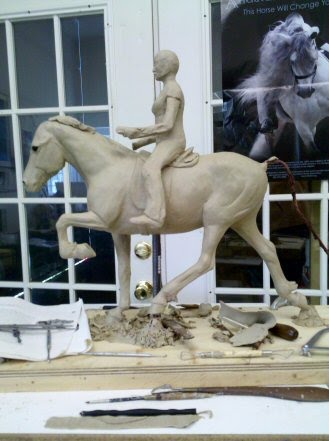
It finally looks like I'm getting somewhere on this piece!  A lot of the previous work has been painstaking and tedious, trying to get the horse built properly, making sure there are no dips or bumps where there shouldn't be, and making the horse a functional being with all the joints in the proper places, etc.  Now I've added a saddle and the rider.  The rider will be removed for shipping - she's only attached by a couple of wires sticking out below her seat bones into the horse.  She'll be welded or soldered in place by the foundry when this piece is cast in bronze.

The saddle is supposed to be an Icelandic saddle.  In addition to looking at the photos I took of my client's two saddles, I researched them online and found quite a wide variation in how they look.  I'm going with the English show saddle look rather than the quilted seat I found on several Icelandic saddles simply because it's less distracting visually to have a smooth seat rather than a quilted one.  I will probably cut the flaps a little shorter - they look too long in comparison with the rider's leg.

I've had to redo the cantle of the saddle about five times now, trying to get it placed right and to make it fit the horse and rider both as well as possible.  I think I'm about there with the cantle.  Now I'm working on the length of the rider's legs and the shape of her boots.  I realized I had cut the wire too short on one leg and had to add some wire to have a good support for her foot.  That's why I'm posting these pics today, to show you how I did that repair.

I've cut off the clay at the bottom of her leg, exposing the wire.  I then attached a lighter wire, wrapping it securely around the existing wire of the leg, using pliers to help me get it as tight as possible.  After wrapping it several times around the larger wire to make it as secure as possible, I started twisting the wire to both strengthen the wire and to give the clay something to bite into so it won't slide around.  (Aluminum wire is slippery to clay if it isn't either twisted itself or isn't wrapped around another wire.)  I doubled the twisted wire (shown above) back on itself and twisted it some more to make it stronger (not shown), then added clay over that to make the new foot.

Here's a closeup of the wire before I folded it back on itself and twisted it again.

Here's the other side of the piece.  This leg is actually a bit too short too, but there's plenty of wire there.  I'll pull the clay off the foot, straighten the wire for a short distance to lengthen the leg, then bend the end up to support the foot and add clay to make the boot again.

I'm having to fight my dressage training in positioning the rider.  She doesn't ride dressage nor do other Icelandic riders (with a few exceptions I know of), so putting her in a dressage position would be wrong.  I haven't had this much trouble positioning a rider in a long time - I guess that shows my dressage training is becoming ingrained!  But I need to be careful about that with my art.  Not all riders ride dressage.

That gorgeous picture behind the sculpture is the International Andalusian & Luisitano Horse Association (IALHA) poster from a couple of years ago featuring the gorgeous stallion, Santiago.  His mane really does reach down past his knees and he seems to have a lovely disposition.  I was fortunate enough to see him at the Midwest Fiesta in 2008 and was given one of these posters then (I had my art booth there marketing my art while I was working on the original of "Feather," which is an Andy stallion now available in bronze).  I had no idea at the time that within a few months of that show, I'd have my very own half-Andalusian (El Paso Aricos, my dressage horse).  Surprise surprise!
This is a picture of my handsome Ricos with my daughter, trainer Jennifer Truett of Dancing Horse Farm, Lebanon OH (www.dhf-oh.com) riding him.  Since I mentioned him in reference to that IALHA poster, I thought I'd include his picture here.  I like this picture so much, I use it as my desktop.

Back to the sculpture:  Don't worry about the rider's face - right now her facial features are more "markers" than anything else.  She doesn't look like herself at all yet!  Her face is even a bit mashed because I grabbed her head and changed the angle of her neck and head from the side (they were too far back).  Her arms and hands haven't been worked on at all yet.  I'll get to them, don't worry!

A lot of sculpting (the way I do it, anyway!) seems to be "take two steps forward, three steps back" at times.  As I work around the piece, I may find that something that looked and measured right before is now too long or too short in relation to some other part and the reference material.  Just  by bending one leg of the rider down so it laid properly along the horse's side changed the way it looked lengthwise, so I had to make some adjustments.  That kind of thing happens frequently.  Just one of the many challenges of 3-D work!
The little lump of clay on the horse's neck is a sign of my eagerness to get to the mane and tail.  They're some of the last things I do on a sculpture, but they're also FUN so I'm eager to get to them.  But it's too soon, so I was just messing around and left it there.

I'm pleased with the progress so far.  Yay!